
Quick Answer: If you have no time, build a daily health routine around a few “minimums”: 5–10 minutes of movement, a protein-and-fibre default meal, steady hydration, and a short wind-down cue for sleep. Make the routine easier to do than to skip by setting up your environment (food, reminders, and bedtime cues) in advance.
If you’re asking how to build a daily health routine when you have no time, the goal is not a perfect plan. It’s a routine that still happens on your busiest days.
Introduction
If your days feel packed from start to finish, you’re not alone. Many people try to “get healthy” by adding big tasks: long workouts, complicated meal plans, strict schedules. Then life does what it always does—meetings run late, kids get sick, your commute drags, you’re tired—and the plan collapses.
A better approach is to build a routine that works at your worst, not just your best. That means picking a few high-impact actions, shrinking them to the smallest useful version, and making them easy to repeat. Over time, those small repetitions add up.
Also, if you’ve been feeling unusually exhausted, short of breath, or “flat” for a while, it’s worth checking for underlying factors. For example, low iron is one possible contributor for some people—here are signs of iron deficiency and what to do (and when to speak with your GP).
In this guide, you’ll build a daily routine using micro-steps for food, hydration, movement, sleep, and stress—without needing extra hours in your day. You’ll also get safety cautions for common situations, so you can adapt the plan responsibly.
🎬 Watch: A quick walkthrough on building a daily health routine when time is tight (including easy defaults for food, movement, and sleep).
📜 Prefer reading? Scroll down for the complete written guide.
The “No-Time” Reality: What to prioritize first
When time is limited, the best routine is the one that protects your baseline: steady energy, stable mood, and reasonable sleep. If you chase perfection, you’ll usually end up with nothing. If you protect the basics, you can still make progress.
Here’s the quiet risk many people miss (and it’s why this matters): when you repeatedly skip food quality, movement, hydration, and sleep, your body often responds with higher stress, more cravings, lower patience, and worse focus. Then the next day gets harder too. That “spiral” is common, and it isn’t a character flaw—it’s biology and logistics working together.
So what do you prioritize? In practice, these tend to give the best return for the least time:
- Sleep cues (not perfect sleep): a consistent wind-down trigger and a cut-off for stimulation.
- Protein + fibre in at least one meal: supports satiety and steadier energy for many people.
- Daily movement (NEAT counts): short bouts add up and support overall health.
- Hydration anchored to existing habits: not extreme, just consistent.
- Stress downshifts you can do anywhere: 30–60 seconds is enough to change your state.
With that foundation in place, you can build a routine that fits your life rather than competing with it.
How to start a health routine when you’re busy
Start by reducing effort before adding tasks. Think of your routine as a delivery system: if the “package” (your healthy action) is hard to deliver, it won’t arrive on busy days. Your job is to make delivery almost automatic.
That means three practical moves:
- Pick a minimum you can do on a bad day. If it only works on a good day, it’s not a routine yet.
- Attach it to something you already do. Teeth brushing, kettle boiling, first meeting, school run—these are anchors.
- Remove decision points. Decisions cost energy. Defaults save it (same breakfast, same snack, same bedtime cue).
Now that we’ve covered the approach, let’s build your routine step-by-step using a practical structure you can copy today.
Step 1: Set your minimum routine (the non-negotiables)
Choose 3 minimums you can do in 10 minutes total
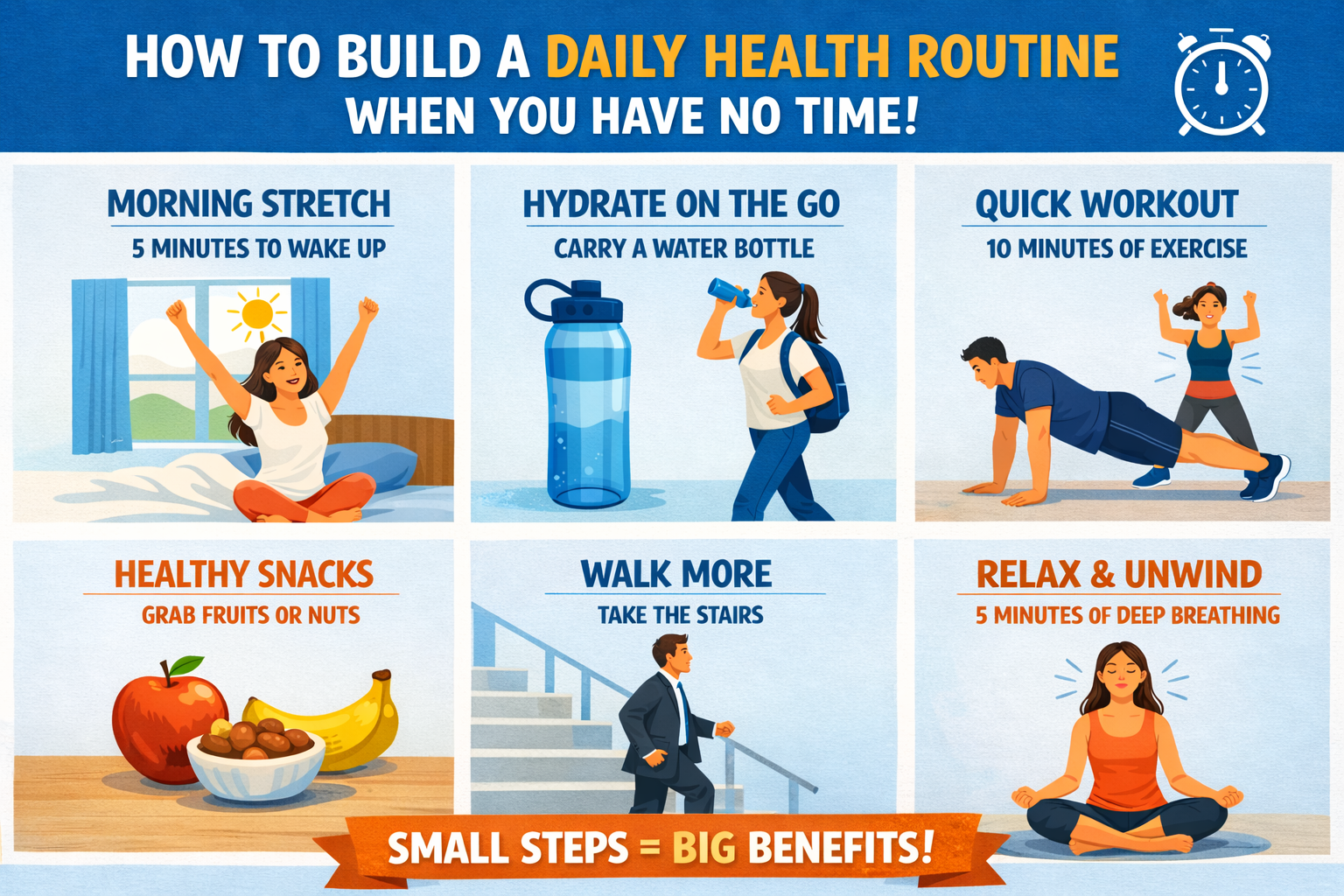
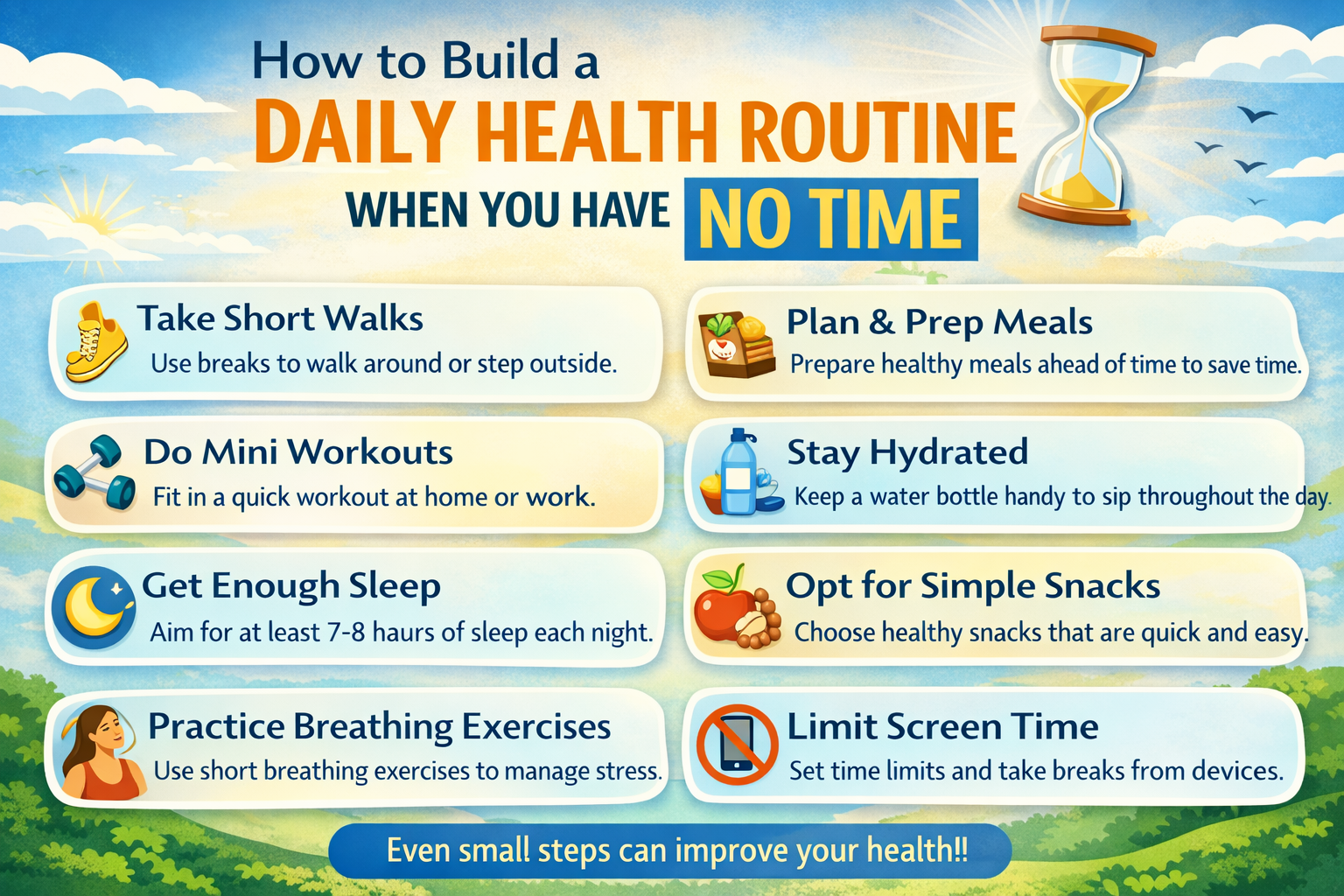
Pick three actions that cover food, movement, and sleep support. Keep them small. For example: drink a glass of water, do 5 minutes of walking or mobility, and set a 30-minute “screens down” reminder before bed.
Attach each minimum to an existing anchor
Tie your minimums to what already happens. Water after brushing teeth. Movement when the kettle boils or during a call. Wind-down reminder when you put your phone on charge.
Plan two “upgrade options” for good days
On a better day, you can extend the habit: 5 minutes becomes 15. One balanced meal becomes two. The routine stays the same; only the size changes.
If you want a plug-and-play starting point, you can also borrow a structure from a simple morning routine for steady energy (especially if mornings are your most predictable window).
✓ Key Takeaways
- Build around minimums you can do on your busiest day.
- Anchor each habit to something that already happens.
- Use “upgrade options” instead of starting over with a new plan.
Step 2: Build a “delivery system” for food and hydration
Food is where busy schedules often hit hardest. When you’re rushed, convenience wins. Rather than fighting that, you can design convenience to work in your favour.
Think of this like a delivery system: the healthier option needs to be the one that arrives fastest, with the least friction. Similar to ingredients in cooking, you don’t need a gourmet recipe every day—you need a few reliable pieces that combine into something decent.
Pick one default breakfast (or first meal)
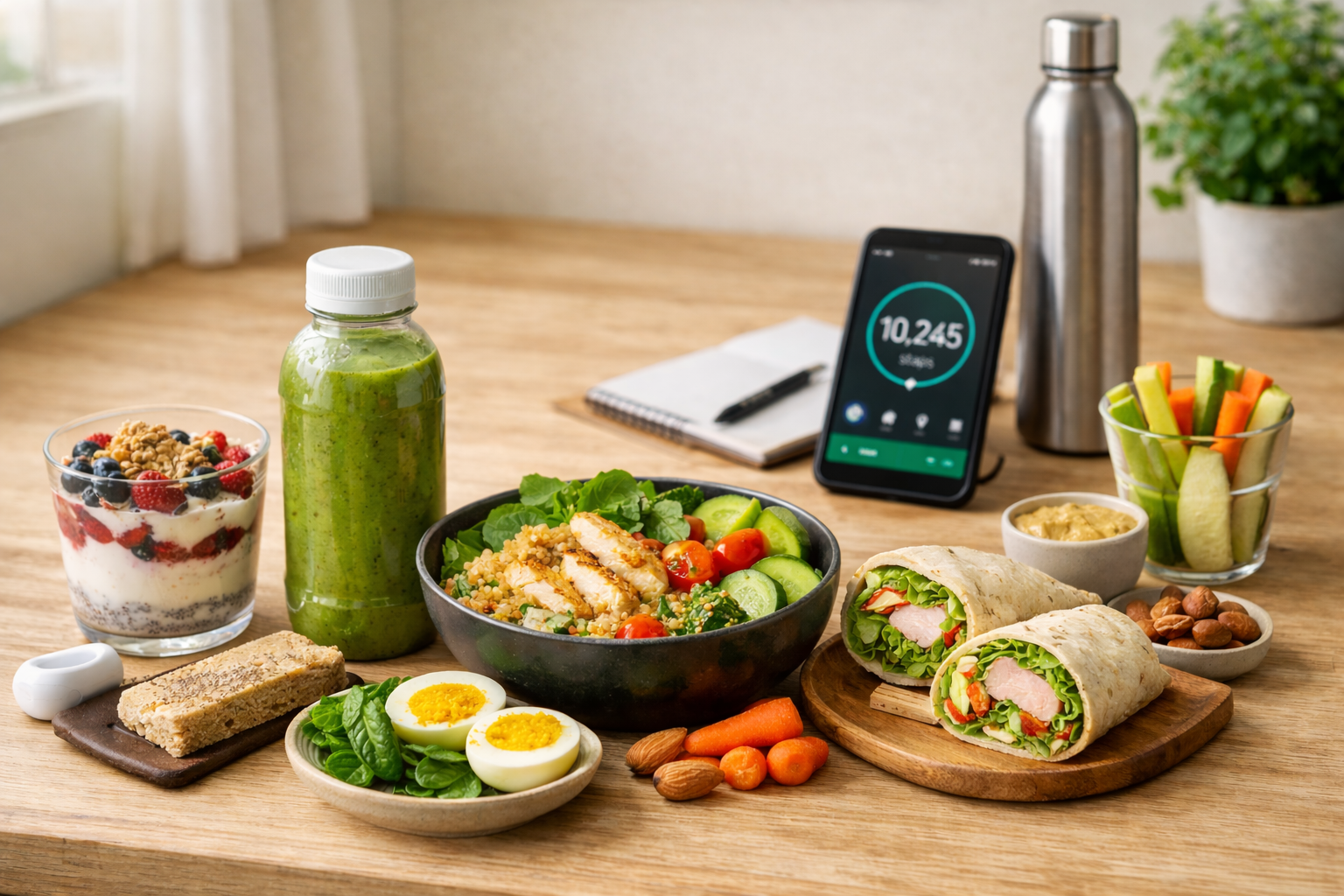
Choose something repeatable with protein and fibre. Examples: Greek yoghurt + fruit + nuts; eggs + wholegrain toast; a simple oats pot with seeds. If mornings are chaotic, make it “grab and go”.
Create a 2-minute packed-lunch template
Use a simple formula: protein + colour + fibre + fat. For example: chicken/tuna/tofu + salad/veg + wholegrains/beans + olive oil/avocado. It doesn’t need to be exciting; it needs to be easy.
Use “fridge and desk defaults” for snacks
Busy days often trigger grazing. Keep a few better options visible and ready: fruit, nuts, yoghurt, cheese portions, hummus, or pre-cut veg. For more options, see grab-and-go snack ideas.
Hydration: attach it to “train times” you already hit
Like catching the right train, timing beats intensity. Pick two dependable moments: after your first drink of the day and mid-afternoon. A bottle you can see often works better than a plan you forget.
Beyond this, remember that “good enough” nutrition on most days can be more realistic—and more helpful—than a perfect plan you rarely follow.
Quick healthy meals when you have no time
When you can’t cook, aim for the best available option, not the ideal one. In UK supermarkets and cafés, look for simple combinations: a protein item (chicken, eggs, beans, yoghurt), a high-fibre base (wholegrain, oats, pulses), and some fruit or veg. If you’re ordering takeaway, you can often improve it by adding a side salad, choosing grilled options, or swapping sugary drinks for water.
If you’re frequently skipping meals, you may notice bigger energy dips. In that case, even a “mini meal” can help—something like yoghurt and fruit, a sandwich with protein, or soup plus bread. The goal is steady fuel, not strict rules.
Step 3: Daily movement without a workout plan
When people say they “don’t have time to exercise”, they often mean they don’t have time for a full workout. That’s understandable. The good news is that daily movement isn’t only about the gym. Short bouts can still matter, especially when you repeat them.
Equally worth discussing: movement can also improve your day immediately. A short walk or a few minutes of mobility may help your mood, concentration, and stiffness—so it can support productivity, not compete with it.
Pick your “minimum movement” (5–10 minutes)
Choose something that needs no equipment: brisk walk, stair minutes, mobility flow, or a short bodyweight circuit. Studies often look at brief activity bouts across the day rather than only long sessions, but results vary by person and intensity.
Use “movement snacks” between tasks
Between meetings or household tasks, do 60–90 seconds: walk around, do calf raises, stretch hips, or do wall push-ups. This reduces the “all-or-nothing” trap.
Make the easy choice the default
Put shoes by the door. Keep a coat ready. If you take calls, take them standing or walking. If you commute, get off one stop earlier when practical and safe.
Another consideration is that pain or dizziness is not something to push through. If movement causes worrying symptoms, scale back and consider checking in with a clinician.
Step 4: Sleep that fits real life
Sleep is often the first thing busy people sacrifice. Yet poor sleep can raise cravings, reduce patience, and make movement feel harder the next day. That’s why a “sleep routine” doesn’t have to be long—just consistent.
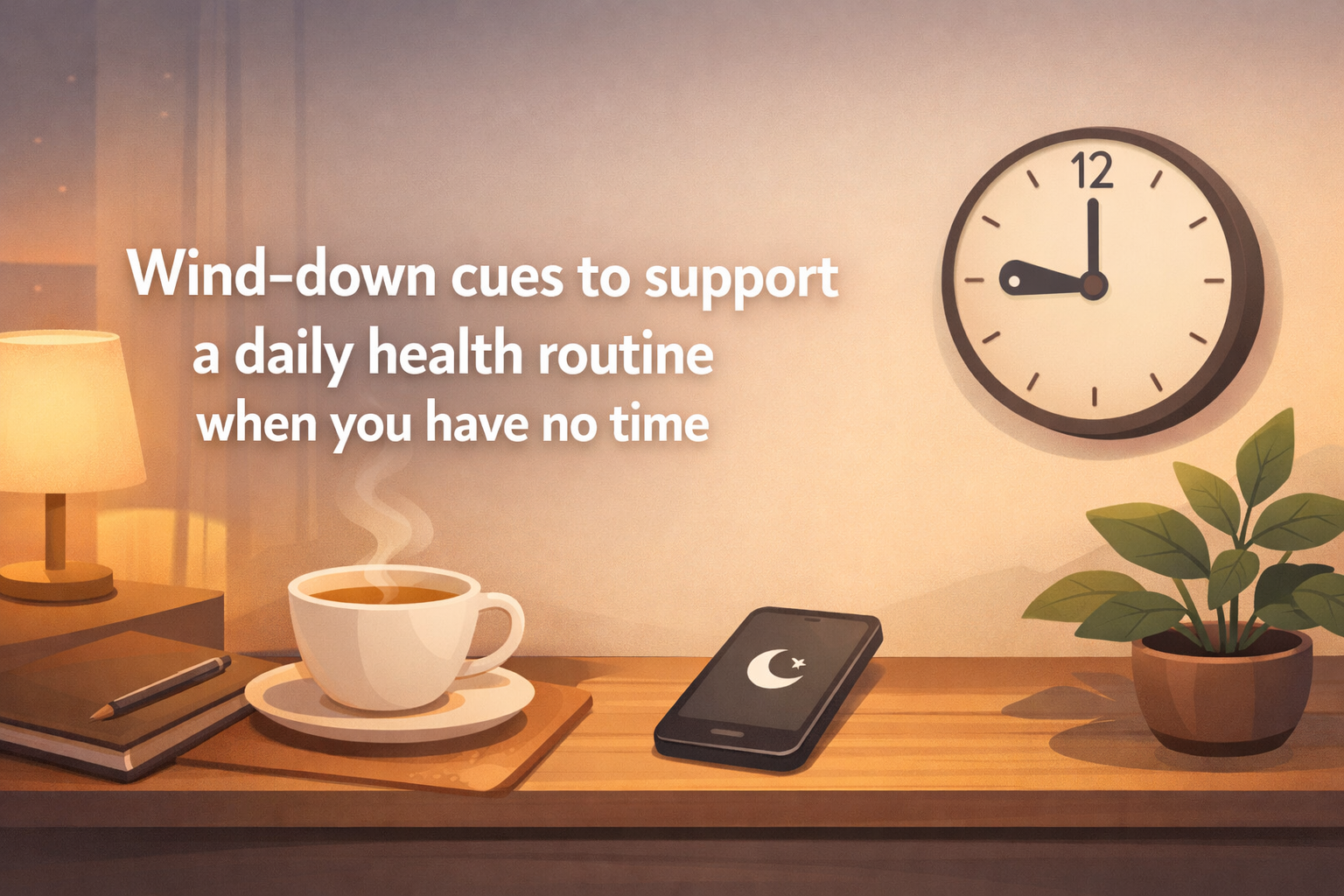
Let’s shift focus to the two levers that tend to be most practical when time is tight: a wind-down cue and a stimulation cut-off. You’re not trying to build a perfect bedtime; you’re trying to give your brain a predictable signal.
Choose one wind-down cue (2–5 minutes)
Examples: dim lights, wash face, set clothes for tomorrow, write a short to-do list, or read two pages of a book. Keep it repeatable. The cue matters more than the duration.
Set a “stimulation cut-off” you can keep
If you can’t do a full hour, do 20–30 minutes. That might mean stopping work email, avoiding intense news, or putting your phone on charge away from the bed.
Protect your “next day you” with a tiny reset
Before bed, reset one thing: fill your water bottle, put fruit on the counter, or pack a snack. That small action reduces morning stress.
If you want a more detailed framework, here’s a helpful reference you can build on: sleep hygiene basics.
Step 5: Stress support in 60 seconds
When time is tight, stress management often sounds like another chore. Still, short downshifts can make a real difference in how you respond to your day—especially if you repeat them. You’re not trying to eliminate stress; you’re trying to lower the peak.
This brings us to the easiest tool to use anywhere: breath. You don’t need special equipment, and you can do it sitting at your desk, in your car (parked), or before walking into your home.
Try a 4–6 breathing pattern (60 seconds)
Inhale gently for about 4 seconds, exhale for about 6 seconds. Repeat 5–6 times. If you feel lightheaded, shorten the breaths and return to normal breathing.
Use a “transition ritual” between roles
Before you switch from work to home (or task to task), do one small ritual: three slow breaths, a short walk to the window, or a quick stretch. It helps your brain change gears.
For more structured options, you can reference Paulinna’s stress breathing guide (especially if you want variety without overthinking it).
💡 Tip: If you only do one thing on a tough day, do a short walk outside. Light + movement is a strong combination for many people, and it often improves sleep later too.
Step 6: Make it stick when life changes (how to build healthy habits that stick)
The biggest challenge is rarely knowing what to do. It’s doing it consistently when your schedule changes daily. The answer is flexibility, not stricter rules.
Building on this, use “if–then” planning. It’s simple: if your normal plan breaks, you already have a backup. That reduces the chance you abandon the day entirely.
Write two backups for each minimum
If you miss your walk, do 5 minutes of stairs or mobility. If you miss your planned lunch, grab a protein option and fruit. If bedtime is late, still do your wind-down cue for 2 minutes.
Track “done”, not “perfect”
Use a simple tick list. If you did the minimum, you win. Over time, that consistency often leads to bigger upgrades naturally.
Make your environment do the work
Put the healthy option where you can see it. Put the “effortful” option further away. This is not about willpower; it’s about design.
If you’ve ever felt stuck because you “fell off”, try treating every day like a new train. Missing one doesn’t cancel the whole timetable—you just catch the next one.
Pairings that work well together (small habits, bigger impact)
Some actions reinforce each other. When you pair them, the routine feels smoother and the benefits are often more noticeable. Similar to ingredients in cooking, the individual pieces may be simple, but together they make something satisfying.
| Combination | Synergy Type | Why It Works | Evidence |
|---|---|---|---|
| 10-min walk + morning daylight | ⏱️ Timing | Light and movement can support alertness during the day and may help sleep timing later. | ⭐⭐ |
| Protein at lunch + fibre snack | 🛡️ Protection | Often supports satiety and steadier afternoon energy, which can reduce late-day grazing. | ⭐⭐ |
| Water after teeth brushing + bottle on desk | 🔄 Absorption | An anchor plus visibility increases follow-through and reduces forgetting. | ⭐ |
| 2-min tidy + bedtime cue | ⚡ Activation | A small reset reduces morning stress and makes the next day’s routine easier to start. | ⭐ |
Evidence: ⭐⭐⭐ Strong | ⭐⭐ Moderate | ⭐ Emerging
Evidence Snapshot
| Claim | Evidence Level | Summary |
|---|---|---|
| Short bouts of activity can support health when repeated | Moderate | Many studies suggest benefits from accumulated movement, though outcomes depend on intensity and consistency. |
| Protein and fibre often improve satiety for many people | Strong | Diet research commonly supports protein and fibre for fullness, which may help with steadier eating patterns. |
| Consistent sleep cues can support sleep routines | Moderate | Sleep hygiene approaches are widely recommended, but the best cues are individual and depend on life constraints. |
| If–then planning can improve follow-through on habits | Moderate | Behaviour research often supports simple planning methods, especially when paired with clear cues and realistic goals. |
🩺 Expert Note
When people feel they have “no time”, the winning routine is usually the one that reduces friction first: prepare one default meal, one movement minimum, and one sleep cue, then repeat. If persistent fatigue, dizziness, low mood, or appetite changes are affecting daily life, it’s sensible to speak with a GP to rule out issues such as nutrient deficiencies, thyroid problems, or sleep disorders.
Safety Considerations and Precautions
This article is educational and not medical advice. Most healthy routines are safe for most people, but there are situations where you should adapt your plan or get clinical guidance.
In particular, be cautious if you are pregnant, have a heart condition, diabetes, an eating disorder history, chronic fatigue symptoms, or you take prescription medication. Also, if you experience chest pain, fainting, severe breathlessness, or sudden weakness, seek urgent medical help.
| Combination | Risk Level | Interaction | Recommendation |
|---|---|---|---|
| High-intensity exercise + very low sleep | HIGH | May increase injury risk, worsen recovery, and raise stress in some people. | Prefer light movement and prioritise sleep until you’re back to baseline. |
| Skipping meals + heavy caffeine use | MODERATE | Can worsen jitters, reflux, anxiety, or later-day energy crashes for some people. | Aim for a small protein-containing meal before (or alongside) caffeine. |
| Late-night screen time + trying to “force” early sleep | MODERATE | Mental stimulation can delay wind-down and make sleep feel harder. | Use a realistic cut-off and a short wind-down cue you can keep. |
| New exercise plan + joint pain or dizziness | HIGH | May indicate you need a gentler progression or clinical assessment. | Scale back and consider advice from a clinician or physiotherapist. |
| Gentle walking + regular meals + hydration | LOW | Generally low risk for most people. | A safe baseline routine for many schedules. |
⚠️ Important: If you’re changing diet or activity and you have a medical condition, are pregnant, or take medication, it’s sensible to check with your GP or qualified healthcare professional.
Frequently Asked Questions
What’s the smallest daily health routine that still helps?
A useful minimum is often: drink water twice a day at set anchors, do 5–10 minutes of movement, eat one protein-and-fibre meal, and use a short wind-down cue at night. It’s small, but it covers the basics that influence energy and consistency. When life is busy, repeating a smaller routine usually beats attempting a bigger plan you rarely do.
How do I build a routine that survives late nights and stress?
Use backups. If sleep is short, prioritize light movement, hydration, and a balanced first meal instead of intense training and strict dieting. Keep your wind-down cue even if bedtime is late, because it protects consistency. Also, reduce decisions by using defaults (same breakfast, same snack options) so stress doesn’t push you into “whatever is easiest”.
Is it better to exercise in the morning or evening if I’m busy?
The best time is the one you can repeat. Morning can work if it’s predictable, while evening can suit people who need more time to wake up. If evening exercise disrupts sleep for you, go earlier or keep it lighter. If mornings are chaotic, consider short movement breaks during the day instead of chasing one perfect workout window.
What should I eat when I don’t have time to cook?
Aim for “best available”: protein + fibre + fruit/veg where possible. In a supermarket, that might be yoghurt plus fruit, a protein sandwich with salad, or soup plus a wholegrain roll. If you rely on takeaway, choose options with a clear protein source and add veg where you can. Over time, a few dependable choices reduce stress and improve consistency.
How can I stay consistent when my schedule changes daily?
Build around anchors that always happen (waking up, first drink, commuting, charging your phone). Then plan two backups for each habit so you’re never stuck. Track “done” instead of “perfect”, and keep the minimum small enough that you can do it even on rough days. Consistency is usually a systems problem, not a motivation problem.
When should I speak to a GP about fatigue or low motivation?
If fatigue is persistent, worsening, or comes with symptoms like dizziness, breathlessness, palpitations, low mood that feels unmanageable, or sudden changes in appetite or weight, it’s sensible to speak with a GP. There can be many causes, and it’s safer to check for underlying issues rather than assuming it’s only lifestyle. Getting clarity can make your routine more effective.
Final Thoughts
Learning how to build a daily health routine when you have no time is mostly about designing for real life. Start with a minimum routine that takes 10 minutes, attach it to anchors you already have, and reduce decisions by using defaults for meals, movement, and bedtime cues. Then add upgrades on good days rather than rewriting the plan.
If you want one next step, choose your three minimums today and set your environment up to support them. A water bottle you can see, snack options that are ready, and a phone charging spot away from the bed can do more than a complicated schedule. For stress support that fits a busy day, you can also use Paulinna’s stress breathing guide as a simple add-on.
Sources
- NHS — Healthy lifestyle tips
- NHS — Sleep hygiene
- NHS — Balanced diet guidance
- PubMed — Brief physical activity benefits
- PubMed — Habit formation and implementation intentions
- Harvard Health — Micro-habits and health
- Cleveland Clinic — Stress breathing exercises
- Examine — Protein and satiety
Written by Arsim Rama
Health Content Specialist · 5+ years in nutrition research
Arsim Rama specializes in translating complex nutrition science into practical, evidence-based guidance. His work focuses on supplement safety, efficacy, and helping readers make informed health decisions.
🩺 Medically Reviewed By: Mavran Todl, Clinical Nutrition Specialist
Last medical review:
Affiliate Disclosure: This article may contain affiliate links. If you purchase through these links, we may earn a small commission at no extra cost to you. We only recommend products we genuinely believe in and have researched thoroughly.
Medical Disclaimer: This article is for educational purposes only and does not constitute medical advice. Always consult your GP or qualified healthcare professional before making changes to your health regimen, especially if you take medications or have existing health conditions.
© 2026 Paulinna. All rights reserved.