
Quick Answer: How to choose quality supplements, prioritise label transparency (no proprietary blends), verify third-party testing (like GMP or Informed Sport), and match the bioavailable form (e.g., Citrate or Glycinate) to your specific health goals.
What defines a high-quality supplement?
In a market filled with “mega-doses” and bold claims, quality is defined by transparency. A high-quality product is one where the manufacturer proves that what is on the label is exactly what is in the bottle, using forms your body can actually absorb.
Most people don’t need a cupboard full of tablets. But when you do consider one, the tricky part is quality: not every capsule is the same, and marketing can sound more confident than the evidence.
Disclosure: This article contains affiliate links. If you purchase through these links, we may earn a small commission at no extra cost to you.
Within the first few minutes of reading a label, you can usually tell whether a formula is designed to inform you—or to distract you. This guide is written for UK readers and uses “food supplement” rules, cautious wording, and a safety-first approach.
🎬 Watch: How to maximise absorption and avoid common pitfalls with your daily supplements.
📜 Prefer reading? Scroll down for the full written guide.
✓ Key Takeaways
- Start with your goal and whether food-first fixes the issue.
- Prefer labels that show exact ingredient amounts and forms.
- Look for credible testing and traceability signals—not hype.
- Safety matters most if you’re pregnant, older, or on medicines.
How do you identify a high-quality supplement?
At its core, this approach is a structured way to decide whether a product is worth considering: you define the purpose, verify the label, check quality signals, and then confirm it’s appropriate for your situation.
It’s also a mindset shift. Instead of asking “What’s the strongest one?”, you ask “Is it transparent, sensible, and safe for me?”. That question alone helps you avoid a lot of poor choices.
Why quality matters more than hype
Quality is not just about “premium” branding. It’s about whether what’s on the label is likely to be what’s in the capsule, in a usable form, at a sensible dose, and made with reasonable controls.
In the UK, most supplements are regulated as foods, not medicines. That means manufacturers are responsible for safety and compliance, and claims must fit authorised wording for specific nutrients rather than implying disease treatment.
So what does that mean for you? It means you can’t rely on the marketing. You rely on transparent labels, conservative claims, and quality signals you can check.
Step 1: Start with your “why” and your health context
Before you buy anything, define what you want it to do in plain language. Is it to fill a likely dietary gap, support a restricted diet, or complement a plan recommended by a professional?
✅ Your “Why” Checklist (2 minutes)
- ☐ I can explain my goal without medical claims (“support intake”, “top up”, “help meet needs”).
- ☐ I’ve considered food-first options and whether they’re realistic for me.
- ☐ I know whether I’m in a higher-risk group (pregnancy, kidney issues, medicines).
- ☐ I’m willing to stop and seek advice if I get side effects or interactions.
If your aim is vague—“more energy”, “detox”, “reset”—it’s easier to be sold something unnecessary. Clear goals help you choose conservative, sensible options instead of chasing promises.
How to verify supplement purity: Step-by-step checklist
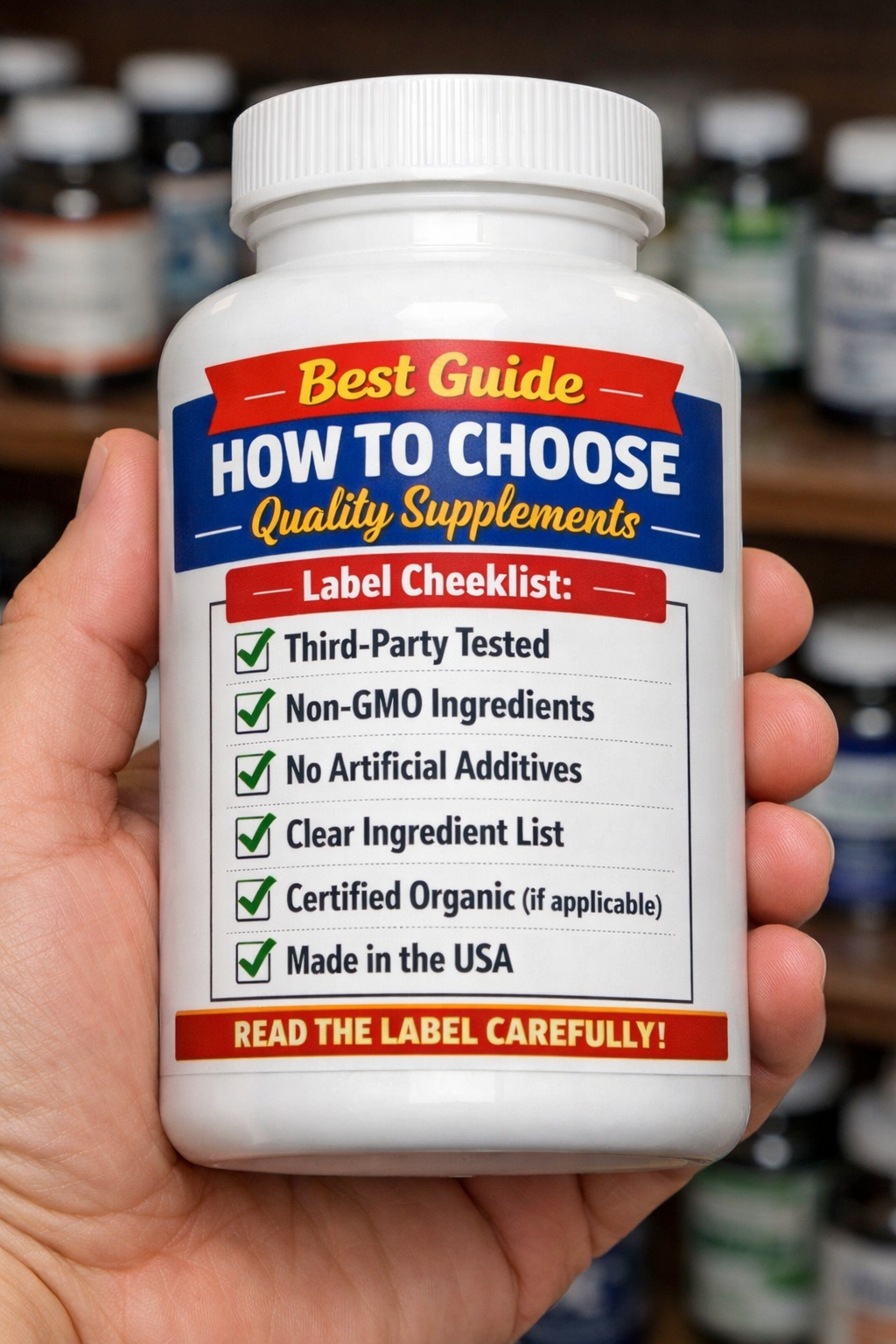
This is the practical “shopping list” you can use on any product page. It’s designed to work quickly, without needing lab knowledge or insider jargon.
✅ The 10-Point Quality Checklist
- ☐ Full ingredient list with exact amounts per serving (no hidden blends).
- ☐ Ingredient forms are specified (e.g., citrate/glycinate; not just “magnesium”).
- ☐ Dose looks sensible vs UK reference intakes and safe upper levels where relevant.
- ☐ Clear usage instructions and warnings for high-risk groups.
- ☐ Allergen info is provided (and suits your needs).
- ☐ Quality statement is specific (batch testing, COA availability, traceability).
- ☐ Claims are cautious and align with authorised nutrient wording (not “cure/treat”).
- ☐ Manufacturing details are credible (GMP or equivalent standards stated clearly).
- ☐ Customer-facing support exists (contact details, returns, clarity on questions).
- ☐ You can explain why you’re choosing this option over food-first alternatives.
If a product fails several items here, it doesn’t automatically mean it’s unsafe—but it does mean you have less reason to trust it. In that case, you can often find a clearer alternative.
Step 2: Read the label like a pro (and spot red flags)
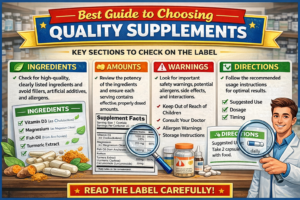
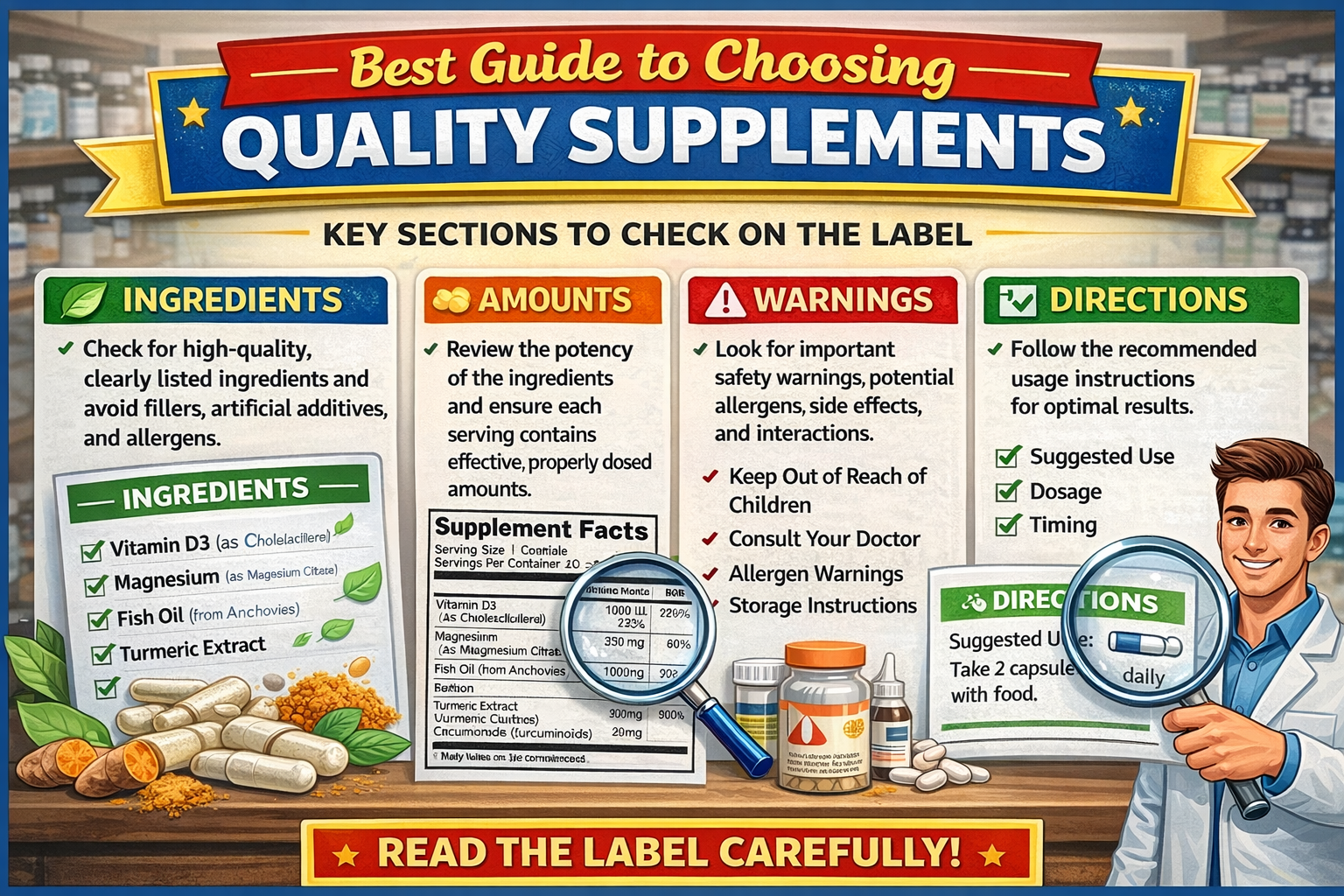
Label-reading is the fastest way to separate a well-designed formula from a marketing-led one. You’re looking for clarity: what it is, how much you get, what form it’s in, and who should avoid it.
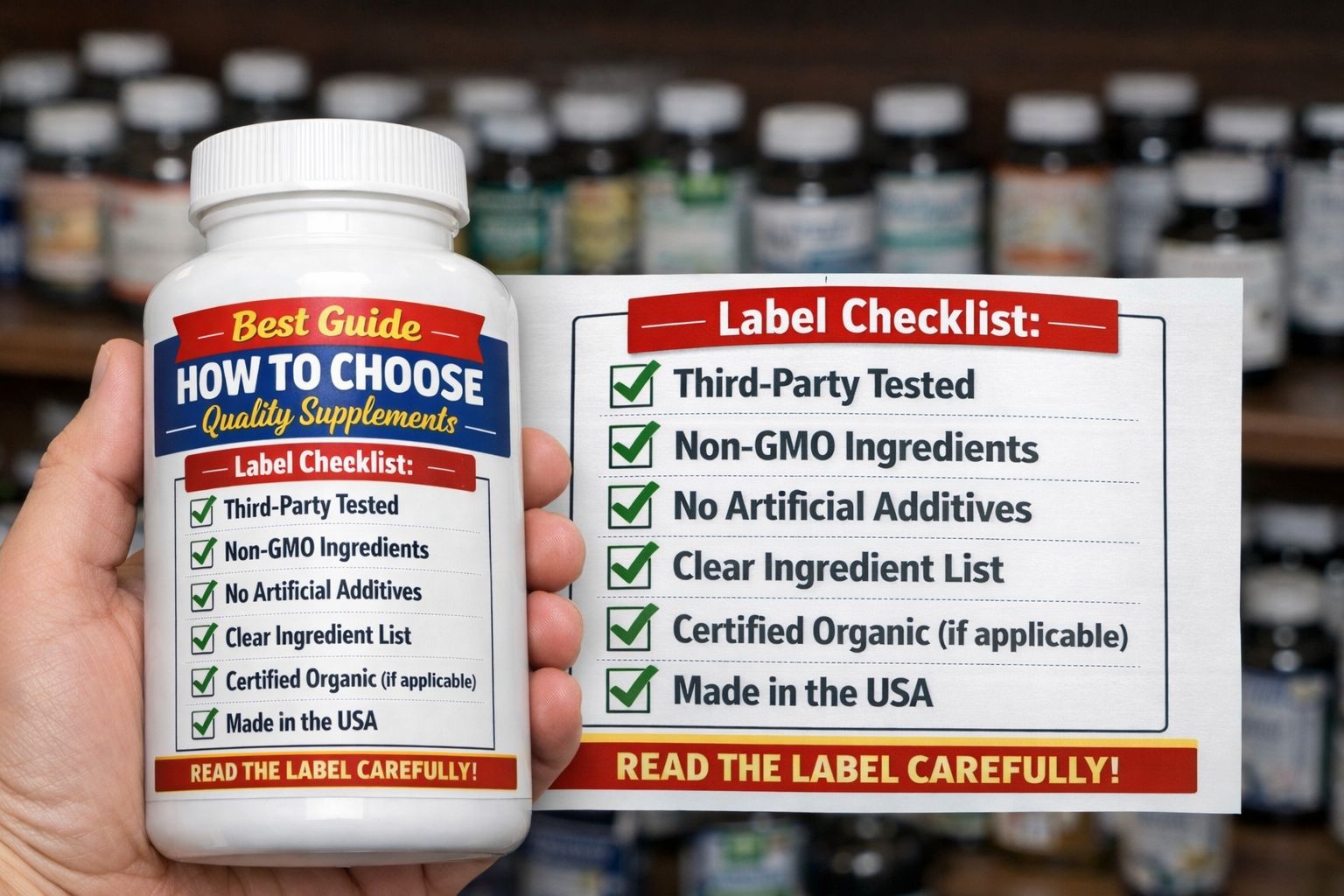
✅ Label Red-Flag Checklist
- ☐ “Proprietary blend” without exact amounts per ingredient.
- ☐ Vague naming (“herbal complex”, “advanced matrix”) with no standardisation details.
- ☐ Mega-doses that look extreme for everyday use, without clear justification and warnings.
- ☐ Claims that imply treating disease or replacing medicines.
- ☐ Missing safety notes (pregnancy, medicines, medical conditions).
Also pay attention to the “supporting ingredients” (capsule shell, binders, sweeteners). For most people, they’re fine, but if you have allergies or sensitivities, they can matter.
Why verifying purity matters (Practical Benefits)
Using a structured buying method doesn’t “guarantee results”, but it can meaningfully improve your odds of choosing something appropriate, tolerable, and worth the money.
Here are the practical wins people usually notice when they stop relying on hype and start relying on labels and quality signals: fewer impulse buys, fewer products that cause discomfort, and clearer expectations about what a supplement can and can’t do.
✅ Practical “Benefits” Checklist (realistic, not promotional)
- ☐ You’re more likely to choose products with clear doses and forms.
- ☐ You reduce the chance of stacking overlapping ingredients unknowingly.
- ☐ You spot questionable claims early and avoid disappointment.
- ☐ You make safer decisions if you’re on medicines or have a health condition.
If that sounds a bit boring, good. “Boring and clear” is often what quality looks like—especially for everyday vitamins and minerals.
Step 3: Claims vs evidence (UK-compliant wording)
In the UK, authorised claims for vitamins and minerals are tightly defined. Brands may still use persuasive copy, but the safest approach is to look for wording that matches approved claims and avoids disease language.
For example, wording such as “contributes to normal immune function” (where authorised for the nutrient) is different from “boosts immunity” or “prevents colds”. The first is a permitted style of claim; the latter can be misleading or non-compliant.
| Common marketing phrasing | Safer, compliant-style wording | What to check |
|---|---|---|
| “Boosts immunity” | “Contributes to normal immune function” | Which nutrient, and whether the claim is authorised for it |
| “More energy instantly” | “Contributes to normal energy-yielding metabolism” | Dose sensibility and whether you’re deficient |
| “Fixes cramps” | “Contributes to normal muscle function” | Form, dose, hydration, and medical causes to rule out |
| “Detox cleanse” | Avoid vague promises | Look for specific nutrients, clear purposes, and warnings |
If you’re unsure, default to conservative interpretation: a supplement may help you meet nutrient needs, but it shouldn’t be framed as a treatment.
Step 4: Quality signals that actually matter (testing, standards, traceability)
Quality signals are only useful if they’re specific. “Premium grade” is marketing. “Batch tested with a certificate of analysis available” is a checkable statement.
✅ Quality Signals Checklist
- ☐ Batch testing is stated clearly (not just “tested”).
- ☐ COA (certificate of analysis) is available on request or via QR/batch lookup.
- ☐ Supplier/ingredient traceability is described in plain terms.
- ☐ Manufacturing standards are referenced credibly (GMP or equivalent).
- ☐ Contact details exist for questions about allergens, batches, or warnings.
For botanical products, quality becomes even more important: look for standardisation, plant part used, and clear amounts. If you only see “herbal blend”, you can’t judge dose or comparability.
Step 5: Dose, form, and usability (a mini-rubric)
Even when two products contain the same nutrient, the form can affect tolerability and how easy it is to use consistently. The “best” choice is often the one you can take comfortably, at a sensible dose, without stacking duplicates elsewhere.
| Factor | Option A | Option B | Best for |
|---|---|---|---|
| Bioavailability (general) | Often higher (chelated/citrate-style forms) | Often lower (some oxide-style forms) | People seeking better tolerance |
| Digestive ease | Often better tolerated | May be harder for some | Sensitive stomachs |
| Cost | Usually higher | Usually lower | Budget-focused choices |
| Dosing frequency | Often 1x daily | Sometimes split doses | People who prefer simplicity |
This is also where people accidentally overdo it. If you take a multivitamin and then add single nutrients, check the totals so you’re not doubling up without meaning to.
Who Should Be Careful or Avoid This
Some people can browse and choose casually. Others should treat supplements like “medicine-adjacent” products and be more cautious, even if the item is sold as a food supplement.
✅ Safety-First Checklist (don’t skip)
- ☐ Pregnancy or breastfeeding: check suitability with a professional, especially for vitamin A, iodine, and botanicals.
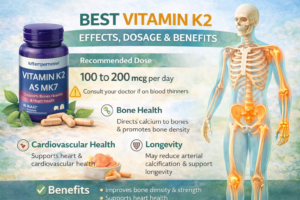
- ☐ Blood thinners or anticoagulants: be cautious with vitamin K and certain herbs; ask a clinician.
- ☐ Kidney disease: avoid high-dose minerals unless advised; dose and form matter.
- ☐ Over 65: review interactions and simplify to essentials where possible.
- ☐ Children: use child-appropriate products only, with professional guidance if needed.
If you notice side effects (digestive upset, headaches, palpitations, rash), stop and seek advice. “Natural” doesn’t guarantee tolerability, and interactions can happen.
Products (2 options): two formulas designed for transparency
These options are presented as examples of what “clear labelling + sensible design” can look like. They’re not medical treatments, and they won’t be appropriate for everyone—use the checklists above first.
Cacao Magic pure collagen – Planet Paleo
Cacao Magic with Pure Collagen by Planet Paleo is a soluble powder that contains collagen peptides from free-range, grass-fed cows and uplifting organic cacao with coconut milk and vanilla. This pouch makes 25 cups of hot chocolate with all of the above.
- ✓ Grass-fed, free-range bovine collagen peptides,
- ✓ Manufactured in the UK by Planet Paleo,
- ✓ Gluten, dairy, grain, sugar and soya-free,
- ✓ Free from pesticides, growth hormones or antibiotics.
Mineral multi capsules – G&G
120 multi mineral capsules each containing 13 essential minerals, of which 8 are chelated. A vegan multi mineral supplement designed by G&G to be highly digestible.
- ✓ Suitable for vegetarians and vegans,
- ✓ Kosher approved,
- ✓ Contains no gluten, soy or lactose.
Frequently Asked Questions
How can I tell if a supplement is actually high quality in the UK?
Look for three non-negotiable signals: GMP certification (Good Manufacturing Practice), a full ingredient breakdown (avoiding “proprietary complexes”), and third-party batch testing. In the UK, reputable brands will often have an “Informed Sport” or “LGC” logo, confirming the product has been independently tested for purity and banned substances.
Are supplements in the UK regulated by the MHRA or FSA?
Most vitamins and minerals are regulated as “food” by the Food Standards Agency (FSA), meaning they don’t undergo the same pre-market testing as medicines. Only products making medicinal claims or those containing specific herbal ingredients (look for the THR logo) fall under the MHRA (Medicines and Healthcare products Regulatory Agency) remit. This is why checking for independent lab reports is vital for safety.
Can I take supplements while using weight-loss medications like GLP-1s?
Because GLP-1 medications (like Wegovy or Mounjaro) slow your digestion, they can significantly affect how your body absorbs supplements. It is essential to consult your GP or pharmacist before starting a new regimen, as you may need specific bioavailable forms or altered timings to ensure you aren’t experiencing nutrient malabsorption or increased side effects.
What is the difference between “synthetic” and “bioavailable” forms?
A “synthetic” form, like Magnesium Oxide, is often cheaper but harder for the body to absorb (low bioavailability). A “bioavailable” form, such as Magnesium Glycinate or Methylcobalamin (Vitamin B12), is structurally similar to what is found in nature, making it easier for your digestive system to process and use effectively.
How do I check the “Safe Upper Limit” for a supplement?
In the UK, you should refer to the NHS guidelines or the British Dietetic Association (BDA) “Food Facts” for safe upper levels. Be cautious of “Mega-dose” supplements imported from the US; these often exceed the UK safe limits for nutrients like Vitamin B6 or Vitamin D, which can lead to toxicity over time if not medically supervised.
Should I trust supplement reviews on TikTok or Amazon?
No. User reviews are anecdotal and cannot verify the chemical purity or safety of a product. To rank quality, ignore the star rating and instead look for a Certificate of Analysis (CoA). A quality brand will provide this document upon request to prove the batch is free from heavy metals, mould, and pesticides.
Final thoughts
Best Guide how to choose Quality Supplements is less about finding a “perfect” product and more about making safer, clearer decisions you can explain. If the label is transparent, claims are cautious, and the formula fits your needs, you’re already ahead of most marketing.
Sources
- NHS. “Vitamins and minerals.” NHS. View source
- British Dietetic Association. “Supplements.” BDA. View source
- Food Standards Agency. “Food supplements.” FSA. View source
- MHRA. “A guide to what is a medicinal product.” MHRA. View source
- GB Nutrition & Health Claims Register. UK Government. View source
- NIH Office of Dietary Supplements. “Dietary Supplement Fact Sheets.” NIH ODS. View source
Written by Arsim Rama · Last reviewed: January 2026
Affiliate Disclosure: This article contains affiliate links. If you purchase through these links, we may earn a small commission at no extra cost to you.
Medical Disclaimer: This article is for educational purposes only and does not constitute medical advice. Always consult your GP or qualified healthcare professional before starting any new supplement regimen.