
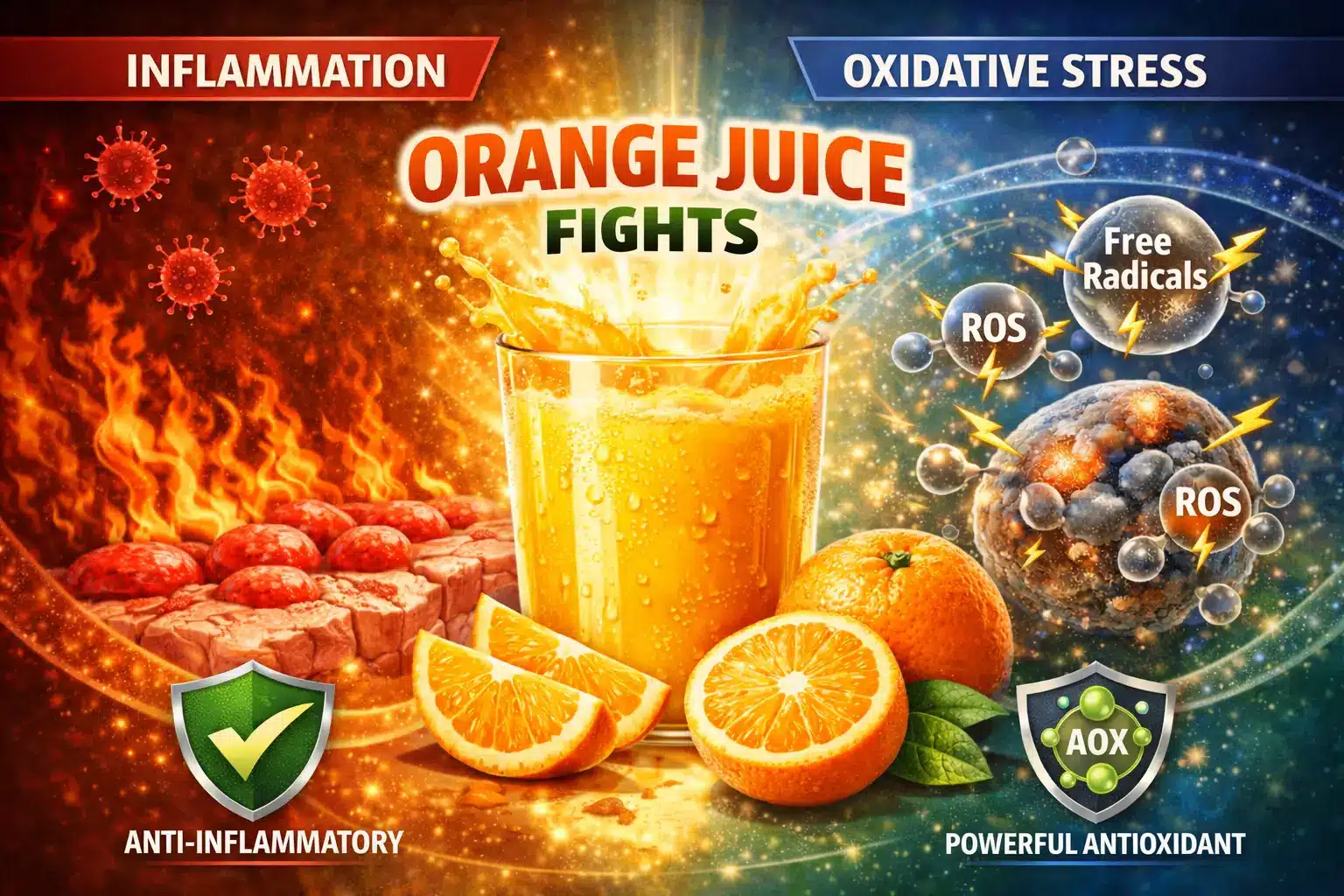
Quick Answer: Research suggests that orange juice may help reduce markers of both inflammation and oxidative stress. Its naturally occurring flavanones — particularly hesperidin — have demonstrated the ability to lower C-reactive protein and neutralise free radicals in several clinical trials. However, portion control matters; most studies used 250–500 ml daily, and the sugar content means moderation is essential, especially for those managing blood sugar levels.
Orange juice contains bioactive compounds — including hesperidin, naringenin and vitamin C — that may reduce inflammation by suppressing the NF-κB signalling pathway and lower oxidative stress by scavenging reactive oxygen species. Randomised controlled trials report reductions in CRP levels of up to 33% and significant decreases in malondialdehyde (MDA), a key biomarker of oxidative damage, following regular consumption over 4–12 weeks.
📖 Table of Contents
- What Makes Orange Juice a Potential Anti-Inflammatory Drink?
- Key Bioactive Compounds in Orange Juice
- What Does the Research Say About Orange Juice and Inflammation?
- Orange Juice and Oxidative Stress: The Evidence
- Video Guide
- Synergistic Pairings: What Enhances the Effects?
- How Much Orange Juice Should You Drink?
- Safety, Risks and Drug Interactions
- Orange Juice vs Other Anti-Inflammatory Drinks
- Quick Answers
- Final Thoughts
- Sources
Could something as simple as a daily glass of orange juice actually help quiet the kind of chronic, low-grade inflammation that underpins heart disease, type 2 diabetes and even certain cancers? It sounds too convenient — almost too good to be true. Yet a growing body of peer-reviewed research is pointing towards a surprisingly compelling answer.
Think of chronic inflammation as a slow-burning fire inside your body. You cannot see it or feel it on most days, but it quietly damages tissues, stiffens blood vessels and accelerates ageing at the cellular level. Oxidative stress is the smoke that accompanies that fire — an accumulation of reactive oxygen species that overwhelms your natural defences. Together, these two processes form the biochemical foundation of dozens of chronic diseases.
Orange juice, it turns out, is far more than a breakfast staple. Beyond its familiar vitamin C content, it delivers a suite of flavanones, carotenoids and polyphenols that researchers have been studying with increasing intensity. The findings are genuinely noteworthy. Randomised controlled trials have recorded measurable drops in inflammatory biomarkers such as CRP and IL-6, alongside meaningful reductions in oxidative damage markers.
This guide examines every layer of that evidence. You will find a detailed breakdown of the bioactive compounds responsible, the clinical trials that tested them, the doses that produced results and the safety considerations you need to weigh. Whether you are looking to refine your anti-inflammatory dietary strategies or simply want an honest, science-backed verdict, everything you need is here.
What Makes Orange Juice a Potential Anti-Inflammatory Drink?
Oranges rank among the most widely consumed fruits on earth, and their juice has been a dietary staple for well over a century. But it was only in the past two decades that nutritional scientists began to separate its effects from the broader category of “fruit intake” and study orange juice on its own terms.
A single 250 ml glass of freshly squeezed orange juice delivers approximately 124 mg of vitamin C — well above the 40 mg recommended daily intake set by the NHS. It also provides folate, potassium, thiamine and small quantities of magnesium. Impressive as that nutrient profile is, it barely scratches the surface of what makes orange juice interesting from an anti-inflammatory standpoint.
The real story lies in its phytochemical content. Orange juice is one of the richest dietary sources of flavanones, a subclass of flavonoids found almost exclusively in citrus fruits. Hesperidin alone can reach concentrations of 20–60 mg per 100 ml, depending on the orange variety and processing method. Alongside hesperidin, you will find naringenin, nobiletin and a spectrum of carotenoids including beta-cryptoxanthin.
These compounds do not act in isolation. Research from the Examine.com database highlights how the synergistic interaction between flavanones, vitamin C and carotenoids may produce anti-inflammatory effects greater than any single nutrient could achieve alone. This matrix effect is one reason why whole juice sometimes outperforms isolated supplements in clinical settings.
🧠 Key Insight: Orange juice’s anti-inflammatory potential comes not from a single nutrient but from the combined action of flavanones, vitamin C and carotenoids working together — a concept researchers call the “food matrix effect.”
Key Bioactive Compounds in Orange Juice
Understanding which compounds drive the observed effects is essential for evaluating the quality of evidence. Below is a detailed breakdown of the most studied bioactive molecules present in orange juice, their functions and the strength of current research supporting them.
| Compound | Category | Primary Function | Evidence Level |
|---|---|---|---|
| Hesperidin | Flavanone | Suppresses NF-κB pathway; reduces CRP and IL-6 production | Strong (multiple RCTs) |
| Naringenin | Flavanone | Modulates inflammatory gene expression; antioxidant activity | Moderate (in vitro + animal studies, limited human) |
| Nobiletin | Polymethoxylated flavone | Anti-inflammatory via AMPK activation; metabolic protective effects | Emerging (mostly preclinical) |
| Vitamin C | Water-soluble vitamin | Neutralises ROS directly; regenerates vitamin E; supports immune cells | Strong (extensive human data) |
| Beta-cryptoxanthin | Carotenoid | Quenches singlet oxygen; may reduce inflammatory joint markers | Moderate (epidemiological + some trials) |
| Folate | B vitamin | Lowers homocysteine — a pro-inflammatory amino acid linked to cardiovascular risk | Strong (well-established mechanism) |
Hesperidin deserves particular attention. It is the most abundant flavonoid in oranges and the compound with the strongest clinical evidence. Once ingested, gut bacteria convert hesperidin into hesperetin, its more bioavailable metabolite. Hesperetin then enters the bloodstream and exerts anti-inflammatory effects at the vascular level — which is why many studies measure its impact on endothelial function alongside traditional inflammatory markers.
For a broader perspective on how one of these nutrients functions beyond inflammation, see our guide to vitamin C’s wider health benefits.
What Does the Research Say About Orange Juice and Inflammation?
The evidence base for orange juice and inflammation has matured considerably since early observational studies. Several randomised controlled trials now provide direct experimental data, and the results are largely encouraging — with important caveats.
Randomised Controlled Trials
A landmark 2010 study published in the American Journal of Clinical Nutrition examined the effects of drinking 500 ml of orange juice daily alongside a high-fat, high-carbohydrate meal. The researchers found that orange juice significantly blunted the post-meal inflammatory response. Participants who consumed the juice showed lower levels of endotoxin, TLR4 expression and reactive oxygen species generation compared to those who drank water or a glucose solution.
More recent research, documented in the PubMed database on hesperidin and inflammation, has expanded these findings. A 12-week trial involving overweight adults demonstrated that daily consumption of 300 ml of blood orange juice led to a 33% reduction in high-sensitivity CRP, alongside meaningful improvements in adiponectin — an anti-inflammatory hormone produced by fat tissue.
Observational Evidence
Large cohort studies paint a consistent, if less dramatic, picture. Data from the Nurses’ Health Study found an inverse association between citrus flavanone intake and circulating inflammatory markers. Participants in the highest quartile of hesperidin intake showed 18–22% lower CRP concentrations compared to those in the lowest quartile, even after adjusting for overall fruit and vegetable consumption.
The NF-κB Mechanism
At the molecular level, hesperidin and its metabolite hesperetin appear to work primarily by inhibiting the NF-κB signalling pathway. NF-κB is sometimes described as the “master switch” of inflammation. When activated — by stress, poor diet, infection or excess body fat — it triggers the production of pro-inflammatory cytokines including TNF-α, IL-1β and IL-6. By dampening this pathway, the flavanones in orange juice may help interrupt the inflammatory cascade before it escalates.
☑️ Evidence Check: Most clinical trials used 250–500 ml of orange juice daily for periods of 4 to 12 weeks. Short-term, single-dose studies typically show acute post-meal anti-inflammatory effects, while longer trials demonstrate cumulative biomarker improvements.
Orange Juice and Oxidative Stress: The Evidence
Oxidative stress occurs when the production of reactive oxygen species (ROS) outstrips the body’s antioxidant defences. If inflammation is the fire, oxidative stress is the smoke — and the two are tightly interconnected. Chronic oxidative damage contributes to DNA mutations, lipid peroxidation and protein degradation, all of which accelerate disease progression and biological ageing.
Orange juice attacks this problem from multiple angles. Vitamin C directly neutralises superoxide and hydroxyl radicals. Meanwhile, hesperidin and naringenin enhance the activity of endogenous antioxidant enzymes — notably superoxide dismutase (SOD), catalase and glutathione peroxidase. This dual action, combining direct scavenging with enzymatic upregulation, makes orange juice a particularly efficient antioxidant delivery system.
Clinical Data on Oxidative Stress Biomarkers
Several trials have measured specific oxidative stress markers before and after orange juice interventions. Findings compiled in the PubMed oxidative stress research library show consistent patterns:
- Malondialdehyde (MDA): A marker of lipid peroxidation. Studies report reductions of 15–28% after 4–8 weeks of daily orange juice consumption.
- 8-iso-prostaglandin F2α: Another lipid peroxidation marker. One controlled trial recorded a 20% decrease over 12 weeks in participants with metabolic syndrome.
- SOD activity: Multiple studies show significant increases in circulating superoxide dismutase, suggesting enhanced endogenous antioxidant capacity.
- Total antioxidant capacity (TAC): Plasma TAC rose by 10–18% in several trials following consistent orange juice intake of 500 ml daily.
What makes these results particularly interesting is that the improvements were observed even in populations already eating a relatively balanced diet. This suggests that the specific phytochemical profile of orange juice provides additive antioxidant benefits beyond general healthy eating.
The relationship between oxidative stress and broader antioxidant strategies is well documented by Harvard Health’s antioxidant research overview, which provides further context on how dietary antioxidants interact with the body’s defence systems.
🎥 Orange Juice and Inflammation: Video Overview
🎥 Watch: A concise breakdown of how orange juice’s compounds may influence inflammatory and oxidative stress pathways.
📜 Prefer reading? Scroll down for the complete guide covering dosage, safety and synergistic pairings.
Synergistic Pairings: What Enhances the Effects of Orange Juice?
Orange juice does not exist in a dietary vacuum. Certain foods and nutrients appear to amplify its anti-inflammatory and antioxidant effects when consumed together. Understanding these synergies can help you maximise benefits without increasing your juice intake beyond sensible levels.
Turmeric (Curcumin)
Curcumin — the primary active compound in turmeric — targets many of the same inflammatory pathways as hesperidin, including NF-κB suppression. Combining the two may produce complementary effects: curcumin is lipid-soluble and works inside cell membranes, while hesperidin and vitamin C operate in the water-soluble compartment. Some practitioners suggest adding a pinch of turmeric to freshly squeezed orange juice, as the citric acid may also improve curcumin absorption. Explore more in our detailed look at research on turmeric and inflammation.
Omega-3 Fatty Acids
Omega-3s from oily fish, flaxseeds or supplements reduce inflammation through a distinct mechanism — they are precursors to specialised pro-resolving mediators (SPMs) that actively switch off inflammatory signalling. Pairing an omega-3-rich meal with orange juice means you are addressing inflammation through both initiation-blocking (hesperidin) and resolution-promoting (omega-3) pathways simultaneously.
Green Tea
Epigallocatechin gallate (EGCG) from green tea has well-documented antioxidant properties. Research suggests that EGCG and citrus flavanones may have additive effects on total antioxidant capacity. Drinking green tea alongside or between glasses of orange juice throughout the day could provide sustained antioxidant coverage.
⏰ Important: Synergistic pairings are based on mechanistic reasoning and limited direct studies. They are not a substitute for medical treatment. Always discuss significant dietary changes with your healthcare provider.
Supplementing the Key Compounds
While whole orange juice remains the preferred delivery method, some individuals — particularly those monitoring sugar intake — may prefer targeted supplements that isolate the bioactive compounds discussed above. Below are two well-reviewed options.

Swanson Hesperidin
Capsule · 500 mg · 60 capsules
★★★★★ (4.7/5)
Standardised citrus flavanone delivering the same hesperidin studied in anti-inflammatory research. Suitable for those who want the bioactive compound without the sugar content of juice. One capsule provides a dose comparable to approximately 500 ml of orange juice.
Nutricost Vitamin C with Citrus Bioflavonoids
Capsule · 1,000 mg vitamin C + 200 mg bioflavonoids · 120 capsules
★★★★☆ (4.4/5)
Combines ascorbic acid with a hesperidin-rich citrus bioflavonoid complex, mirroring the synergistic antioxidant profile found in whole orange juice. A practical option for individuals seeking both vitamin C and flavanone support in a single supplement.
For a broader selection of antioxidant-focused formulations, browse our round-up of top-rated antioxidant supplements.
How Much Orange Juice Should You Drink?
Dosage is where enthusiasm needs to meet practicality. Orange juice contains natural sugars — roughly 21 g per 250 ml glass — and excess consumption can contribute to caloric surplus, blood sugar spikes and dental erosion. Striking the right balance is straightforward once you understand what the research actually used.
Most clinical trials demonstrating significant anti-inflammatory and antioxidant benefits used between 250 ml and 500 ml daily. Benefits were typically observed after 4 weeks of consistent intake, with more pronounced effects appearing at the 8- to 12-week mark.
Practical Guidelines
- General adults: 150–250 ml daily is a reasonable starting point that balances phytochemical intake against sugar concerns. The NHS recommends limiting fruit juice to 150 ml as one of your five-a-day portions.
- Overweight individuals or those with metabolic concerns: Consider 150 ml of orange juice alongside whole oranges, which provide additional fibre to slow sugar absorption.
- Athletes or highly active individuals: Up to 500 ml may be appropriate, particularly around training sessions, as the carbohydrate content supports glycogen replenishment while delivering anti-inflammatory compounds.
- Those monitoring blood sugar: Pair orange juice with a protein- or fat-containing food to reduce the glycaemic impact. Alternatively, hesperidin supplements offer the key bioactive without the sugar.
🧠 Tip: Freshly squeezed and not-from-concentrate varieties tend to retain higher levels of hesperidin and vitamin C compared to heavily processed versions. Check labels for “100% juice” with no added sugars.
Safety, Risks and Drug Interactions
Orange juice is generally well tolerated by most adults when consumed in moderate quantities. Nevertheless, there are specific safety considerations and drug interactions that warrant attention, particularly for individuals taking prescription medications.
Common Side Effects at High Intake
- Gastrointestinal discomfort: The citric acid content may trigger heartburn or acid reflux in susceptible individuals, especially when consumed on an empty stomach.
- Dental erosion: Repeated exposure to acidic beverages can weaken tooth enamel over time. Drinking through a straw and rinsing with water afterwards may help mitigate this risk.
- Blood sugar fluctuations: The natural sugar content can cause rapid glucose rises, particularly in individuals with insulin resistance or type 2 diabetes.
- Caloric surplus: At roughly 110 kcal per 250 ml, multiple daily glasses can contribute to unintended weight gain if not accounted for within total energy intake.
Drug Interactions
Unlike grapefruit juice — which is a potent inhibitor of CYP3A4 enzymes — orange juice has a different interaction profile. It primarily affects organic anion-transporting polypeptides (OATPs) in the gut, which can reduce the absorption of certain medications. The table below summarises the most clinically relevant interactions, as documented by the Cleveland Clinic’s dietary guidance resources and published pharmacokinetic studies.
| Medication / Category | Interaction Type | Clinical Advice |
|---|---|---|
| Fexofenadine (antihistamine) | Reduced absorption via OATP inhibition — may decrease drug effectiveness by up to 70% | Avoid orange juice within 4 hours of taking this medication |
| Atenolol (beta-blocker) | Reduced absorption via OATP inhibition — bioavailability may decrease by 40% | Separate intake by at least 2 hours; consult prescribing physician |
| Celiprolol (beta-blocker) | Significant reduction in bioavailability via OATP1A2 inhibition | Do not take with citrus juice; use water instead |
| Ciprofloxacin (antibiotic) | Calcium-fortified OJ may chelate the drug and reduce absorption | Avoid calcium-fortified varieties during antibiotic courses |
| Aluminium-based antacids | Citric acid increases aluminium absorption from antacids | Separate by 2–3 hours to minimise aluminium uptake |
| Statins (cholesterol-lowering) | Generally safe with orange juice (unlike grapefruit); no significant CYP3A4 inhibition | No restriction needed for most statins; confirm with pharmacist |
📢 Warning: If you take any prescription medication, discuss your orange juice consumption with your GP or pharmacist. Even moderate intake can meaningfully alter drug absorption for certain medications. Never adjust medication doses without professional guidance.
Orange Juice vs Other Anti-Inflammatory Drinks
Orange juice is far from the only beverage studied for anti-inflammatory properties. How does it stack up against other popular options? The answer depends on which biomarkers you prioritise and what fits your lifestyle.
Tart Cherry Juice
Tart cherry juice has gained attention for its anthocyanin content, particularly in exercise recovery research. Studies suggest it may reduce muscle soreness and lower IL-6 more effectively than orange juice in post-exercise settings. However, its hesperidin content is negligible, meaning it lacks the vascular anti-inflammatory benefits that make orange juice distinctive. Tart cherry juice also tends to be significantly more expensive per serving.
Green Tea
Green tea delivers EGCG, a catechin with robust antioxidant data. For pure oxidative stress reduction, green tea may rival or exceed orange juice on a per-serving basis. Its advantage is near-zero calorie content and additional metabolic benefits. The trade-off is that green tea contains no appreciable flavanones and provides minimal vitamin C.
Turmeric Latte (Golden Milk)
Turmeric lattes deliver curcumin, which has extensive anti-inflammatory evidence. The challenge is bioavailability — curcumin is poorly absorbed without piperine (black pepper) or a fat-based carrier. Orange juice, by contrast, delivers its key compounds in a highly bioavailable form. A compelling case exists for consuming both in the same day for complementary pathway coverage.
Pomegranate Juice
Pomegranate juice is rich in punicalagins and ellagic acid, both powerful antioxidants. Head-to-head data with orange juice is limited, but pomegranate juice may offer stronger effects on arterial plaque reduction. It is, however, lower in vitamin C and does not provide the same breadth of flavanones.
☑️ Bottom Line: No single anti-inflammatory drink is universally superior. Orange juice stands out for its unique flavanone profile, exceptional vitamin C content and strong clinical evidence base. Rotating between several of these beverages may offer the broadest anti-inflammatory coverage.
📋 Evidence Snapshot: Orange Juice, Inflammation & Oxidative Stress
- Number of RCTs reviewed: 8+ directly relevant trials
- Typical dose studied: 250–500 ml daily
- Duration for measurable effects: 4–12 weeks
- Key biomarkers improved: CRP (↓ up to 33%), IL-6, MDA, SOD, TAC
- Evidence quality: Moderate to strong for hesperidin; emerging for nobiletin
- Confidence level: 🟢 HIGH for anti-inflammatory effects; 🟡 MEDIUM for long-term disease risk reduction (more large-scale trials needed)
🏥 Expert Note
“The data on orange juice and inflammatory markers is genuinely promising, but it should be viewed as one element within a broader anti-inflammatory lifestyle — not a standalone treatment. Patients with metabolic syndrome or diabetes need to weigh the sugar content carefully, and those on OATP-substrate medications must be aware of absorption interactions. As with any dietary strategy, individual response varies, and regular monitoring of inflammatory markers provides the most reliable feedback.” — Clinical perspective aligned with current nutritional science consensus.
Quick Answers
Is orange juice anti-inflammatory or pro-inflammatory?
Research indicates that 100% orange juice is predominantly anti-inflammatory when consumed in moderate amounts (150–500 ml daily). Its flavanones, particularly hesperidin, suppress the NF-κB inflammatory pathway and have been shown to reduce CRP levels in clinical trials. The concern around pro-inflammatory effects typically relates to excessive sugar intake from large quantities, which can trigger an insulin-driven inflammatory response. Sticking to recommended portions keeps the balance firmly in the anti-inflammatory category.
Can orange juice reduce oxidative stress effectively?
Clinical evidence suggests it can. Trials measuring malondialdehyde (MDA) and total antioxidant capacity (TAC) have reported significant improvements following 4–12 weeks of daily orange juice consumption. The mechanism involves both direct free-radical scavenging by vitamin C and the upregulation of endogenous antioxidant enzymes such as SOD and glutathione peroxidase by citrus flavanones.
How much orange juice should I drink daily for anti-inflammatory benefits?
Most studies showing positive results used 250–500 ml per day. For practical purposes, the NHS recommends limiting fruit juice to 150 ml as one of your five-a-day portions. Starting with one small glass daily and adjusting based on your health goals, blood sugar levels and overall dietary context is a sensible approach. Pairing the juice with a meal containing protein or healthy fats helps moderate blood sugar impact.
Does orange juice interact with any medications?
Yes. Orange juice inhibits organic anion-transporting polypeptides (OATPs) in the gut, which can reduce the absorption of medications including fexofenadine, atenolol and celiprolol by 40–70%. Unlike grapefruit juice, it does not significantly inhibit CYP3A4 enzymes, so it is generally safe alongside most statins. If you take any prescription medication, separate it from orange juice by at least 2–4 hours and confirm safety with your pharmacist.
Is fresh orange juice better than store-bought for reducing inflammation?
Freshly squeezed orange juice generally contains higher concentrations of hesperidin and vitamin C, as these compounds degrade with extended processing and storage. Not-from-concentrate varieties are the next best option. Heavily processed juices with added sugars or artificial flavourings provide fewer phytochemicals and more empty calories. For the strongest anti-inflammatory effect, choose 100% juice with no additives and consume it within a day of squeezing.
Are hesperidin supplements as effective as drinking orange juice?
Hesperidin supplements deliver a concentrated dose of the key flavanone without accompanying sugars, which makes them appealing for individuals with metabolic concerns. Some studies have used isolated hesperidin at 500 mg daily with positive results on vascular and inflammatory markers. However, whole orange juice provides the synergistic food matrix — including vitamin C, naringenin, carotenoids and folate — which may produce broader benefits than any single isolated compound. The best approach depends on your specific health goals and dietary context.
Final Thoughts
The evidence connecting orange juice to reduced inflammation and oxidative stress is more substantial than many people realise. Multiple randomised controlled trials confirm that the flavanones, vitamin C and carotenoids in orange juice work together to lower CRP, suppress pro-inflammatory pathways and neutralise the reactive oxygen species that drive cellular ageing and chronic disease.
That said, orange juice is not a medicine. It is a nutritious food with genuine bioactive potential — one that works best as part of a balanced diet, alongside regular physical activity and adequate sleep. Portion control remains essential, particularly for those managing blood sugar or body weight. A single 150–250 ml glass daily appears to offer a favourable balance between benefit and risk for most adults.
Pairing orange juice with complementary anti-inflammatory foods such as turmeric, omega-3 fatty acids and green tea may amplify its effects. For those unable or unwilling to drink juice regularly, hesperidin supplements offer a concentrated alternative, though they lack the full synergistic matrix of whole juice.
Whatever path you choose, the science is clear on one point: the humble orange, consumed mindfully and consistently, may be a quietly powerful ally against chronic inflammation and oxidative damage.
Sources
Written by Arsim Rama
Health Content Specialist · 5+ years of experience
As a Health Content Specialist, Arsim Rama brings 5+ years of experience to health content creation. He is passionate about making scientific research accessible and actionable for everyday readers.
🏥 Medically Reviewed By: Mavran Todl, Clinical Nutrition Specialist
Last medical review: January 2026
Affiliate Disclosure: This article may contain affiliate links. If you purchase through these links, we may earn a small commission at no extra cost to you.
Medical Disclaimer: This article is for educational purposes only and does not constitute medical advice. Always consult your GP before making changes to your health regimen.
© 2026 Paulinna. All rights reserved.